
Is Autism Funny? joking around Spencer Reid in Criminal Minds
Most portrayals of autism in the media are socially awkward white men. The humor this stereotype relies on can be painful- it was a struggle to watch Sheldon Cooper be a selfish asshole to his friends for no reason in Big Bang Theory.
Good comedy writers know that humor is highly dependent on its application.
So to answer the question: autism can be HILARIOUS- when jokes are done right, much like any other topic.
So how is humor around autism applied in the CBS tv series Criminal Minds?
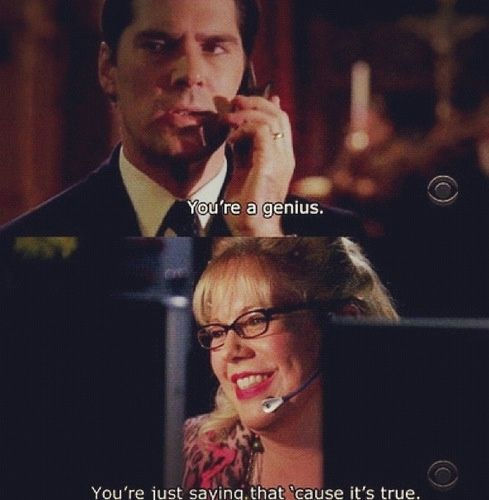
One of our favorite characters is Spencer Reid, who is confirmed by both one of the show's writers and the actor Matthew Gray Gubler himself to be Autistic. While other characters in the series certainly exhibit Autistic and other neurodivergent traits, the examples of humor therein are most abundant around Dr. Reid, so he is the focus of this analysis.
Much of what Criminal Minds does is a mixed bag.
The gratuitous violence drew criticism from main actor Mandy Patinkin, and the writers continue to acknowledge this throughout the series by referencing his character Gideon's opinions on the sensationalization of violence- even as the on-screen depictions grow ever more graphic.
The continuity is pretty good, but main story threads are still dropped and introduced fairly suddenly or even randomly. The characters have depth and exhibit growth, but still have unwavering traits that make them seem one dimensional at times.
So, too, does the humor at Spencer Reid's expense land in a mixture of clever and cringe. We can examine this best by breaking down a selection of scenes which illustrate the humor around autism in Criminal Minds.
Quote:
[Reid quickly completes a puzzle that Prentiss has been struggling with]
Prentiss: There's a lot to hate about you, Dr. Reid.
Rossi: Play poker with him sometime.
Morgan: Try playing chess with him.
Garcia: Or Go.
This scene demonstrates Spencer's ability to succeed at any given strategy game.
The series frequently mentions that he grew up in Las Vegas and has been banned from many casinos due to his card counting abilities. He also frequently plays chess with other intellectual team members, and explains the Japanese strategy game Go in the first episode of the series. Spencer Reid's skill with games is both well-established and believable.
Assessment: Funny!
The humor here is believable, relatable, and not cruel. Even though Prentiss uses the word "hate," she is a kind character. Here, she is merely exhibiting the natural frustration which the whole team feels when falling short of Reid's superior intellect. Her tone is a mix of admiration and resignation.
The calm, amused way in which the other characters deliver their lines tells us this is a feeling they get used to, and have learned to accept that Reid will trounce them at strategy games. It's just a fact of life, and they have given up resentment.
Quote:
The show frequently articulates and demonstrates Dr. Reid's ability to read 200,000 words per minute, and remember every word due to his photographic memory. So if we accept this as true, it is believable that he reread War and Peace for breakfast.
However, I have trouble buying that this translates to effectively processing video surveillance at top speed. Processing stationary written words is a very different skill from tracking the movements of grainy figures flitting about the screen, so this feels like a reach.
Assessment: Not particularly funny
The funniest part of this scene to me is Spencer's line, "Reread it actually, this time in the original Russian," and it gets buried. This may seem like he is bragging, especially after the setup that Derek gives him. To me, this feels more like an Autistic compulsion to be very literal and give all the relevant factual context.
Spencer didn't read War and Peace, he reread it, and can't help making this factual distinction. He then feels the need to elaborate that he reread it in Russian- why? Probably because his eidetic memory means he wouldn't normally need to reread anything, but reading it in another language would make a difference.
The humor in this line derives from the Autistic need for factual precision. Spencer doesn't show off, but he stuns us with his knowledge nonetheless. His quiet, matter-of-fact demeanor when boasting these extraordinary abilities is both Autistic and hilarious.
Instead of just letting this land, Derek closes the scene by exclaiming to the befuddled detective that their "Boy Wonder" can in fact process the films at hyperspeed, landing a "gotcha" moment on the unsuspecting rube who doubts Reid's superhuman abilities. Since this isn't particularly believable, this manufactured situational humor is not nearly as funny as the claim that Reid had War and Peace in Russian for breakfast, which is more in keeping with his established speed-reading abilities.
Quote:
Gideon: "Try again. Fail again. Fail better."
Reid: Samuel Beckett.
Morgan: "Try not. Do, or do not."
Reid: Yoda.
This scene is an amusing juxtaposition between Gideon and Morgan. The fact that Gideon does not know this famous Star Wars quote highlights the difference between their generations.
Assessment: Hilarious!
Reid is not the butt of this joke! He is providing generational translation between Gideon and Morgan, and actually gets the opportunity to deliver a punchline.
Criminal Minds features a quote at the beginning and end of each episode which reflect on the themes explored in the plot. They aren't well known quotes, and the authors are usually stuffy philosophers and novelists like Samuel Beckett. In this instance, the audience gets to enjoy the dramatic irony of knowing something the clever Gideon does not.
Quote:
Reid: You should have listened to me.
Morgan: It wouldn't have saved that much time, Reid, let it go.
Reid: The interchange between the 405 and the 101 freeways is consistently rated the worst interchange in the entire world.
Morgan: Why do you know that?
Reid: The government report.
Morgan: So what?
Reid: So you work for the government, you don't read its reports?
Morgan: On traffic patterns in a city 2,500 miles from where I live?
Reid: 2,295 miles.
Morgan: Don't make me smack you in front of all these people.
If the team needs numbers or statistics, Reid has it memorized, down to the decimal point. This unwavering insistence on exact facts is an Autistic trait that we can choose to either find useful, amusing, or annoying; the tv characters frequently think all three about Reid!
Even though Morgan jokingly threatens violence here, his character has an excellent relationship with Reid.
Assessment: Pretty funny
The humor in this scene continues to expand on his penchant for facts. First, it is amusing that Reid thinks that working for the government means reading the reports, especially his disconnect from what he enjoys reading and what others would enjoy reading.
When Morgan points out how this information is irrelevant to him, instead of conceding that the government report on this city might not concern him, Reid is compelled to correct the statistic with the exact number.
What I like best about this scene is my ability to empathize with both characters. I can understand Morgan's frustration with Reid's statistics as well as I can understand Reid's frustration with being stuck in traffic due to having his applicable knowledge ignored.
Quote:
Reid: I don't know everything. I mean, despite the fact that you think I do.
Morgan: I never said that. When have I ever said that?
Reid: Every day since I met you.
Greenaway: This morning at breakfast.
Hotchner: Yesterday when he beat you at cards.
Morgan: Anyone ever heard of sarcasm?

This scene turns the tables by deriving its humor not from Reid knowing everything, but from commenting on Morgan consistently saying so. This demonstrates some self-awareness from the writers because Morgan and others do say this frequently on-screen.
I also enjoy that this scene features Reid standing up for himself and others supporting him.
Assessment: Pretty funny
It is less than hilarious because Morgan did not deliver his initial line with a sarcastic tone, and so his response is a cop out. If he had laughed and admitted fault, or even actually sounded sarcastic with "When have I ever said that?" then the scene would have landed more amusing and less awkward for me.
Quote:
Reid: [launches into a lengthy and speedy explanation about Doctor Who]
Seaver: [cutting him off] I'm really sorry.
Reid: For what?
Seaver: [exasperated] Asking.
Agent Seaver is the newest member of the team, and hasn't yet adjusted to everyone's foibles. This scene depicts an initial reaction from an outsider to Spencer's rambling.
Assessment: Unfunny and cruel
While this is perhaps an honest reaction, it is unnecessarily rude. It would have been simple for her to reply something like, "I can't follow all of that," or "I have to get back to work," or anything else to excuse herself from the hyper fanboy onslaught. Instead, her language initiates an apology, and then she turns it into a slap in the face.
Fortunately, most of Spencer Reid's longstanding teammates are far more kind and patient with him when he infodumps. In this scene, they just watch with mild amusement. This interaction does provide a point of contrast for his team's usual respect, but still attempts to derive humor from cruelty.
Quote:
Reid: Unlike classic autism, language ability is intact in people with Asperger's. They appear to lack empathy and have trouble reading social cues. Albert Einstein supposedly had it, as do some well-known Silicon Valley types.
Blake: Well, how about you?
Reid: What's that?
Spencer appears not to understand Blake's implication that he seems Autistic, which is sort of funny because he is oblivious to the social cues he has trouble reading and is unable to recognize himself in his own description.
Assessment: A bit funny, but inaccurate
As an Autistic person, I take issue with his initial line because it is incorrect. Language ability is not necessarily "not intact" in "classically" Autistic people, and in particular Asperger's is no longer distinguished as a separate syndrome.
Additionally, with all his understanding of psychology and introspection into his own psyche with regards to genetic schizophrenia, I find it difficult to believe that Spencer would not recognize the Autistic cognitive profile in himself by the seventh season of the show. You could conjecture that the character is not willing to disclose this to his teammates so pretends not to understand Blake as a cover, but that would take away the irony of the line.
Conclusion
In general, the writers of Criminal Minds do a fairly good job of handling Dr. Spencer Reid's character with both humor and grace. Frequently, his teammates respond with patience and good-natured humor to his annoying Autistic traits.
Reid also manages to land some of his own zingers, and not all of the humor is necessarily at his expense.
Examples of the characters being deliberately cruel to each other are few, and the team members tease and support each other in equal amounts. They each have their own quirks, and the show does an excellent job of letting them each be themselves in ways that are well-rounded: dramatic, bad-ass, flawed, and funny.
Comments