
Why Criminal Minds Takes the Cake in Neurodivergent Representation
Updated: Mar 21, 2022
Teamwork in the Behavioral Analysis Unit
CBS’s Criminal Minds is a procedural drama focusing on a team of FBI agents who catch serial offenders by analyzing their behavior. The TV series explores many themes, such as human nature, good and evil, systemic and poetic justice, and how the choices we make define us. One of the strongest recurring themes is teamwork.
It is clear that no individual character is equipped to succeed alone, and working together is the only way to solve these crimes. Working alone is almost always featured as a point of pride that results in the character’s downfall, and splitting up or going in without backup usually results in death or severe injury.
Made up of a mostly white cast, the characters are written to build a well-balanced team. Each of the characters bring their own unique background, skill set, and perspective. As such, the whole team does an excellent job of accepting and supporting each other. They trust in each others’ strengths, look out for their weaknesses, and treat each other with kindness and compassion.
This environment of radical acceptance means that the characters who demonstrate Autistic and ADHD behaviors tend to receive, more often than not, the appropriate reactions and support from their teammates. In mainstream cinema, these neurodiverse characters and their positive interactions are noteworthy.
Spencer Reid
I love the portrayal of Dr. Reid as an Autistic individual, and his positive working and personal relationships with other members of the BAU team.
We know agent Spencer Reid is canonically Autistic because in the first season, one of the characters criticizes Jason Gideon by saying he is unable to diagnose the apparent Asperger’s in his protegee, Reid. This episode came out in 2005, when public understanding of the word Asperger’s was even more limited than today.
In another episode featuring a non-speaking autistic child, Reid does not self-identify as Autistic, but he is the only person able to successfully communicate with the child. Reid understands how the child experiences the world through routines, patterns, and visuals. He intuitively picks up on how this impacts his communication.
Autistic features like Spencer’s eidetic memory, IQ of 187, heightened pattern perception, and difficulty forming social connections are frequently mentioned throughout the series. TVtropes.org says that his condition is ambiguous, but also that one of the show’s writers and the actor who plays Spencer Reid himself have confirmed that he is Autistic.
Reid: Do you think that [being interested in weird things] is why I can't get a date? Elle: Have you ever asked a girl out? Reid: No. Elle: That's why you can't get a date.
In particular, Dr. Reid usually contributes to the team by info-dumping, spouting facts and chattering about his special interests. This is always presented as either highly valuable to solving the case, or when he does it at inappropriate times, a colleague kindly and firmly tells him to stop- and he does.
This little interaction always means a lot to me. Autistic people do not tend to read non-autistic social situations well. Instead of framing him as a brilliant brainiac who always performs flawlessly, the writers humanize Reid by showing us these social faux pas.
Better yet, they show the audience the appropriate way to respond to Autistic people: with kind and direct communication.
While some team members exhibit frustration (or jealousy) with Reid from time to time, they are almost always loving and supportive. Responses include things like, “Save it,” “Now’s not the time,” “Give it a rest, kid,” “Slow down,” “Layman's terms, please?” in a firm and/or playful tone, often with a smile.
In reaction, Reid stops, refocuses, clarifies, etc. He is aware of his behavior and how it affects others. This awareness doesn’t enable him to prevent himself from, well, being himself, but he is able to redirect when prompted. This is a very accurate portrayal of an enthusiastic Autistic person.
Furthermore, Reid almost never apologizes for rambling. This is important because the audience does not receive messaging that he has anything to be ashamed of.
He is who he is, and he is proud of it. Nevertheless he does not act like a self-righteous asshole, the way many Autistic caricatures are written for a cheap laugh. The other characters as well express appreciation for Spencer Reid’s ability to be unapologetically himself.
Aaron Hotchner
I consider Aaron Hotchner to be coded as at least ADHD, if not also Autistic. This character is the rule-follower, and Hotchner’s unyielding insistence on the truth at all times is a very Autistic trait. Autistic people tend to both value objective truth and hard facts, and exhibit rigid thinking patterns.
This is also based on the understanding that ADHD people respond well to crisis situations.
So we don’t see Hotchner exhibiting the stereotypical “flaky” ADHD behaviors, but the audience almost always sees him in hyperfocus because the series mostly shows us when the team is working on crises.
As team leader, Hotchner must have an excellent mask. He holds himself to high standards and must be an unshakable constant for the team.
He is a man of few words, which to me underscores a neurodivergent masking technique. The less you say, the less you fuck up. This pattern is certainly a device to portray him as the stereotypical, mysterious FBI agent who answers questions with questions- but we rarely see him opening up to his team members, either.
Two of Aaron Hotchner’s lines of dialogue in particular caught my attention and solidify my interpretation of his character as ADHD.
When asked how he manages his work life balance, he replies that when he is with his family, he tries to give them 100% of his attention, and same with respect to his team.
This isn't a definitive example, because blocking out distractions is just imperative to the urgent nature of their work. Equally important is compartmentalization, for the social, emotional and mental well-being of all the agents in the BAU, due to the horrific crimes they deal with every day.
However, Hotchner’s line illustrates the techniques ADHD people must use in order to function. We are compelled to shift our attention and multi-task, but to be most effective, we have to learn to control our focus. By specifying this need to regulate his attention and displaying hyperfocus behaviors, Hotchner becomes relatable for ADHD viewers.
More specifically, when asked about what he will do with his vacation, Aaron Hotchner replies,
“My wife has a list of chores a mile long and I can’t wait! The biggest decision I have to make is what to do first.”
This response is surprising and funny to neurotypical viewers; no one wants to do chores on their vacation!
To me, this demonstrates Hotch’s need to keep busy. Hyperactive presentations of ADHD are characterized by an internal motor that compels us to keep moving. Doing chores is a great way for Hotch to keep busy and contribute to his household and relationship with his family through physical activity.
The second sentence of this line is just as important to his neurodivergent characterization. As team leader, Hotchner calls all the shots. All the responsibility is on his shoulders, and he has to make split second life and death decisions. He is good at his job and is able to do this through extensive training, but for those of us with executive dysfunction, being relieved from decision-making responsibilities is a vacation!
Lastly, Hotchner is frequently shown pulling late nights, early mornings, and all nighters at the BAU office. It is often implied that he rarely, if ever, sleeps. This is another example of the hard-working, intense boss-guy trope, but together with the other traits, it presents as ADHD. In addition to regulating our attention, we also have delayed circadian rhythms, and Autistic people frequently have sleep problems as well.
The canonical evidence of Aaron Hotchner’s neurodivergence is limited, and perhaps the writers themselves didn’t make coding him that way a conscious decision.
However, I find his personality, behavior and dialogue sufficiently demonstrate both Autistic and ADHD traits. This conclusion seems very plausible given that such a high-stakes job requiring interdisciplinary intelligence and the ability to think outside the box is certainly a role in which neurodivergent people would excel.
Penelope Garcia
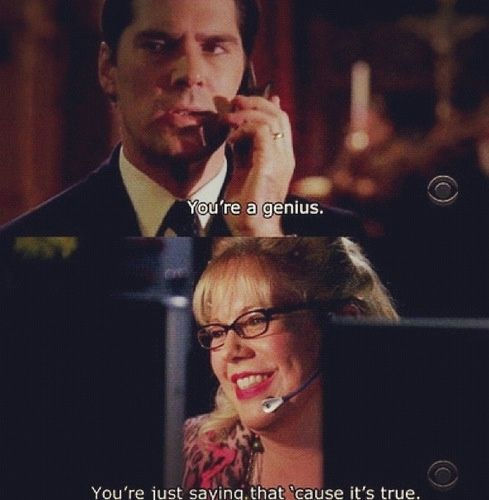
I would be remiss not to mention the neurodivergent whimsy of Penelope Garcia that holds the BAU team together.
Her signature bright colors, bold outfits, and desk covered in cheery tchotchkes all demonstrate her bright personality. Garcia is almost never featured without iconically colorful and well-accessorized clothing. It is as much of her personality as her charmingly flippant communication style.
Garcia is another positive portrayal of neurodivergence because the team always both values her technical contributions and recognizes how her peppy personality is valuable for morale.
Recruited by the FBI after she tried to hack their database, the audience is frequently reminded that Garcia’s skills are technical rather than crime-solving. She demonstrates an inability to understand why people do bad things, and this strong sense of justice is a very Autistic trait. Her character is always shown as soft, sensitive and kind-hearted, saying the only way she can bear to look at the horrors on her screen is because she surrounds them with her happy decorations.
Reid: You know Garcia, she carries a laptop, not a gun. She can’t even look at
crime scene photos without needing pictures of panda bears to counterbalance
them.
Garcia frequently mentions how much comfort her unicorns and fuzzy pens and other chipper do-dads bring to her, which is an excellent example of an Autistic visual stim. When Garcia is briefly transferred to another unit, she has as much of a hard time giving up these comforting items as her colorful wardrobe. How protective she is of her space also demonstrates Autistic tendencies.
Even though she is portrayed as gossipy and caring deeply about her friends, Garcia also makes frequent mention of enjoying her solitude, preferring her “lair” to working in the field or the bullpen with her colleagues. When Jason Gideon spends an episode in her office, she is so irritated with him disrespecting her space that Hotch actually sends her flowers to apologize. In fact, even the second-sweetest member of the team, JJ, piques Garcia’s irritation when she sets a coffee on Garcia’s desk, or stabs a push-pin into her wall.
Since she works mostly from her office, much of her time to shine comes from answering phone calls when the team needs her technical analysis expertise. Examples of how Penelope Garcia answers her phone:
“Your friendly neighborhood Oracle of all things knowable and unknowable at your service.”
“Rainmaker, how wet do you want it?”
“Office of Unfettered Omniscience – how may I help you, O fortunate one?
Additionally, the actress delivers many of her lines with Autistic prosody, meaning the cadence of her voice is more whimsical than “normal.”
Though she tries to rein in it when speaking to authority figures at her job, even the ever-stiff Hotchner appreciates Garcia’s idiosyncratic ways of speaking. He specifically reaches out to tell her “thank you” for her good work after she catches him off guard by accidentally being a little too casual with him. When she struggles with the profiling aspect of the job, he tells her, “I know you see the good in people, Penelope, always. And I would never want you to change that.”
In order to let her shine, Hotchner typically avoids calling Garcia directly himself. The team recognizes her chemistry with Derek Morgan, so contacting her is usually his job. Though Morgan is arguably the most neurotypical human on the team, he always shows appreciation for Garcia’s banter.
Similar to how Dr. Reid is portrayed as not really being able to help his info-dumping, Garcia’s unprofessional speech patterns are demonstrated as a sort of compulsion as well. One episode features Morgan answering the phone and telling her,
“You’re on speakerphone, so behave,” to which she promptly replies,
“Or what, you’ll spank me?”
Cue eyeroll from Morgan and facepalm from Garcia.
Conclusion
As a TV show with a plot driven by behavioral analysis, it would be difficult not to have interesting interpersonal relationships among the main characters. What Criminal Minds does really well is getting the facts right, which includes dimensional characters with strengths, flaws, preferences, and dynamic personalities.
Even though the Autistic implications for Spencer Reid’s character may seem ambiguous to the general audience, key traits are obvious for Autistic viewers. Furthermore, these Autistic traits are shown to be either a neutral aspect of his personality or positive contributions to the team, while still keeping him human and relatable… even if there are a few laughs about the character’s superhuman abilities.
Aaron Hotchner has less direct evidence for his neurodivergence, but is still highly relatable for ADHD and Autistic viewers. Hotchner’s intense need to keep moving, success in a high stakes job, and rigid insistence on truth stick out as quirks that are actually neurodivergent traits. In fact, many characters are written this way unintentionally, because patterns of neurodivergent behavior are often recognizable as “quirky” to the uninformed, although they might not understand the neuroscience behind these tendencies.
The quirkiest character on the team by far is Penelope Garcia. She is allowed to dress brightly because she doesn’t work in the field, and her office is just as cheerily decorated as she is! We see these as examples of visual stims and needing to control her environment, coupled with her fierce protectiveness of her space. She also gets away with saying cheeky and downright odd things on the phone in an effort to keep both the team and the show itself upbeat.
Ultimately, it is not just the fact that Criminal Minds features Autistic and ADHD characters, or even that these representations are positive and nuanced.
What sets Criminal Minds apart is the way the other team members interact with their neurodivergent colleagues.
It’s not always perfect. They struggle. But overall, this TV show sets an excellent example of how people of different neurotypes and varying communication styles can work together to lift each other up and succeed as a team.

Comments